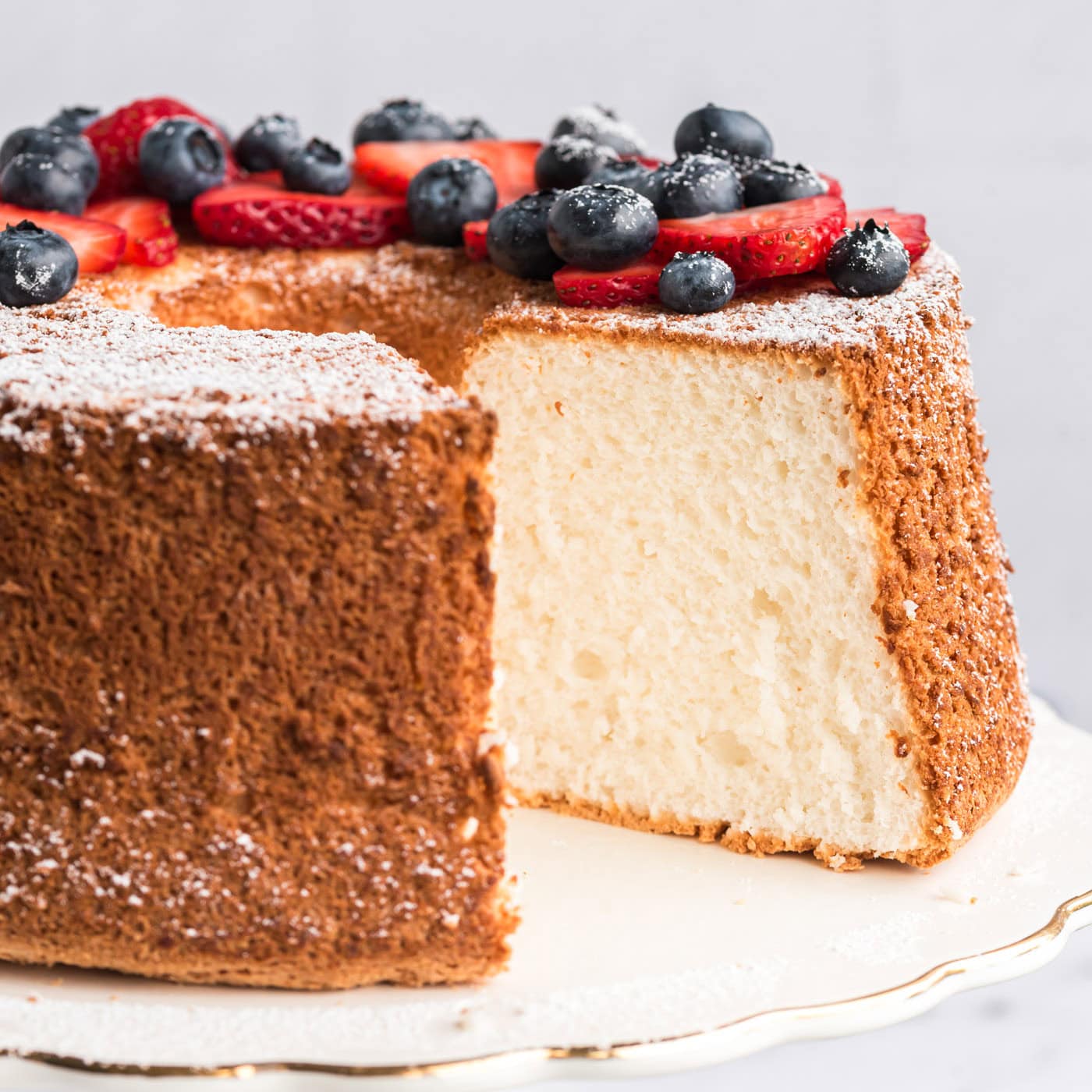
Angel Food Cake
A towering, snow-white cake leavened by nothing but whipped egg whites, with a springy crumb and a thin chewy crust. It uses no butter, no oil, and no baking powder — just air, sugar, and patience.
Ingredients
Makes 1 ten-inch tube cake (12 slices)
Cake
Instructions
- 1
Set up the oven and pan
Move an oven rack to the lower third of the oven and heat to 350°F. Set out a 10-inch two-piece tube pan and leave it completely bare — no butter, no spray, no parchment. The batter has to grip the sides of the pan to climb, and any trace of fat will send it sliding back down. If your pan has ever been greased and not fully scrubbed, wash it in hot soapy water and dry it now.
- 2
Make superfine sugar
Pour all 1 1/2 cups of sugar into a food processor and run it for about a minute, until the crystals look powdery. Scoop out 3/4 cup and set it aside for the meringue. Finer sugar dissolves into the whites instead of weighing them down, which is the difference between a cake that climbs and one that sulks. Skip this step if you already have caster sugar.
- 3
Combine the dry ingredients
Add the sifted cake flour and salt to the remaining sugar in the processor and pulse five or six times to lighten and combine. Sift the whole mixture into a bowl and set it beside your mixer. If you don't have a processor, whisk the flour, salt, and sugar together and sift them twice.
- 4
Start the meringue
Wipe the mixer bowl and whisk with a paper towel dampened in white vinegar to strip off any invisible grease, then dry them. Add the egg whites and beat on medium-low until loose and foamy all the way through, about 1 minute. Sprinkle in the cream of tartar and keep beating until the foam turns white and holds the faint tracks of the whisk.
- 5
Add the sugar slowly
With the mixer on medium, add the reserved 3/4 cup sugar about a tablespoon at a time, waiting a few seconds between additions. This takes 4 to 5 minutes and it is not a step to rush. Stop when the meringue is thick, glossy, and holds a peak that curls over at the tip — soft to medium, never stiff and chalky. Overwhipped whites have nowhere left to expand in the oven and will collapse. Beat in the vanilla and almond extract on low just until they disappear.
- 6
Fold in the flour
Take the bowl off the mixer. Sift about a quarter of the flour mixture over the surface and fold it in with a large flexible spatula: cut down through the center, sweep along the bottom, and lift the batter over itself, rotating the bowl a quarter turn each time. Repeat with the remaining flour in three more additions. Stop the moment you can't see dry streaks — a few folds too many costs you an inch of height.
- 7
Fill the pan
Spoon the batter into the ungreased pan, then run a thin knife or skewer through the batter in a slow circle to pop any large trapped bubbles. Smooth the top with an offset spatula. The pan should be roughly two-thirds to three-quarters full.
- 8
Bake
Bake for 35 to 40 minutes, until the top is deep golden, feels springy and dry rather than tacky when you press it, and a skewer inserted into the thickest part comes out clean. Cracks on the surface are normal and expected. Resist opening the oven before the 30-minute mark.
- 9
Cool upside down
Immediately invert the pan onto its feet, or slide the center tube over the neck of a sturdy bottle so the cake hangs clear of the counter. Leave it completely alone for at least 2 hours. Gravity is what keeps the still-soft crumb stretched out while the sugars set; cool it right side up and it will compress into itself.
- 10
Release and slice
Run a thin knife or offset spatula firmly around the outer wall and the center tube, pressing against the metal rather than the cake. Lift out the insert, release the bottom the same way, and turn the cake onto a plate. Cut with a serrated knife using a gentle sawing motion — pressing straight down will squash it flat.
You did it! Help us bring baking back home by selling your delicious baked goods on Homebaked!
Baker's Tips
- 1.
Separate the eggs while they're cold straight from the fridge, when the yolks are firm and less likely to break, then let the whites sit on the counter for 30 minutes before whipping. Warmer whites whip to a greater volume.
- 2.
Even a speck of yolk will keep the whites from reaching full volume. Crack each egg into a small bowl first and transfer the clean white to the mixing bowl, so one bad egg doesn't ruin the batch.
- 3.
Use freshly separated whites rather than the carton kind. Cartoned and previously frozen whites are pasteurized and simply don't trap as much air.
- 4.
A two-piece tube pan with a removable bottom is worth buying. Nonstick, silicone, and greased bundt pans all fight the batter's ability to climb.
- 5.
Soft, droopy peaks are the target. If the meringue looks grainy, dull, or separates into clumps when you lift the whisk, you've gone too far and the cake will bake up short and tough.
- 6.
You'll be left with 12 yolks. Refrigerate them covered for up to two days and turn them into lemon curd, crème brûlée, or hollandaise.
- 7.
Angel food cake is dry by design and wants something alongside it: macerated strawberries, lightly sweetened whipped cream, lemon curd, or thick slices seared in a dry pan until the edges caramelize.
Equipment
- 10-inch two-piece tube pan (ungreased)
- Stand mixer with whisk attachment, or electric hand mixer
- Food processor or blender
- Fine-mesh sieve or sifter
- Large flexible spatula
- Serrated knife
- Glass bottle with a narrow neck, if your pan has no cooling feet
Storage
Keep the cooled cake under a cake dome or loosely wrapped in plastic at room temperature for up to 3 days; it stays softest this way. Refrigeration dries it out quickly, so skip it unless the cake is frosted or filled. To freeze, wrap the whole cake or individual slices tightly in plastic and then foil and freeze for up to 2 months, thawing at room temperature still wrapped. Avoid airtight containers while the cake is even slightly warm, since trapped steam turns the delicate crust gummy.