Classic Butter Pound Cake
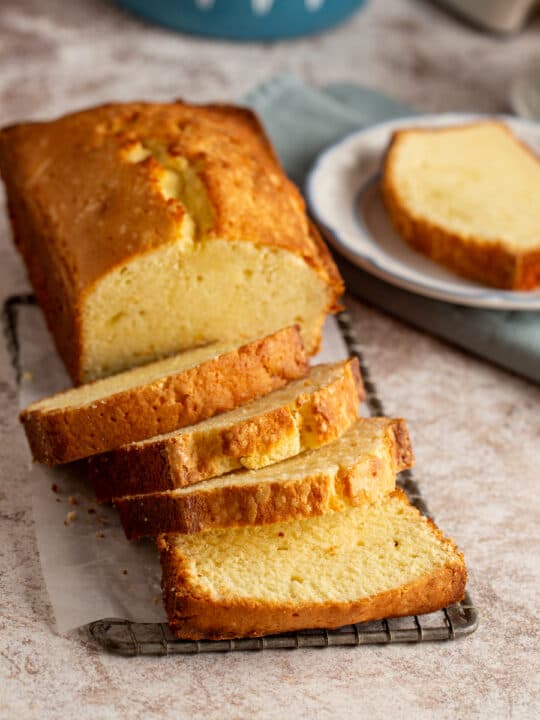
A dense, golden loaf with a buttery crumb and a crackled top, built on the old four-ingredient formula with just enough sugar and milk to keep it moist. It slices clean, keeps for days, and tastes like it came from a very good bakery.
Ingredients
Makes 1 loaf (12 slices)
Cake
To finish
Instructions
- 1
Heat the oven and prep the pan
Set a rack in the center of the oven and heat it to 325°F. Butter a 9x5-inch metal loaf pan, then line it with a strip of parchment that hangs over the two long sides so you can lift the cake out later. Butter the parchment too. The low oven is deliberate: this is a tall, heavy batter, and a hotter oven sets the crust long before the middle catches up.
- 2
Get everything to room temperature
Press a finger into the butter. It should dent easily but still hold its shape, around 65 to 67°F. Greasy, melty butter will not hold air, and cold butter will not either. The eggs and milk should feel cool-neutral, not fridge-cold. If your eggs are straight from the fridge, sit them in a bowl of warm tap water for 10 minutes.
- 3
Cream the butter and sugar properly
Beat the butter alone with a paddle on medium speed for about a minute until it's smooth and glossy. Add the sugar in a steady stream, then beat on medium-high for 5 to 7 full minutes, stopping twice to scrape the bowl and paddle. You're looking for a mixture that has gone almost white and climbed noticeably up the sides of the bowl. This is where nearly all the lift in a pound cake comes from, so don't shorten it.
- 4
Add the eggs slowly
Whisk the eggs with the vanilla in a measuring cup with a spout. With the mixer on medium, pour them into the butter in a thin, patient stream over 3 to 4 minutes. Rushing here is the classic way to break the batter. If it does look curdled and separated, add 2 tablespoons of the measured flour and beat for 30 seconds; it will usually pull back together.
- 5
Fold in the dry ingredients
Whisk the flour, baking powder, and salt together in a separate bowl. Add about a third to the batter and fold it in with a flexible spatula, cutting down through the center and sweeping up the sides. Repeat with the remaining flour in two more additions, then fold in the milk. Stop the moment the last streak of flour disappears. The batter should be thick enough to mound on the spatula.
- 6
Fill the pan and score the top
Scrape the batter into the pan and smooth the surface, nudging it slightly higher at the two short ends than in the middle. For that signature bakery split down the center, run the back of a wet spoon in a shallow trench down the length of the batter, or lay a thin ribbon of softened butter in the same line.
- 7
Bake low and slow
Bake for 60 to 75 minutes. The cake is done when it's deep gold, the crack in the center looks dry rather than wet, the sides have pulled slightly away from the pan, and a skewer in the thickest part comes out with no wet batter. An instant-read thermometer should show 205 to 210°F. If the top is browning hard before the center sets, tent it loosely with foil at the 45-minute mark.
- 8
Cool before slicing
Let the cake rest in the pan on a rack for 15 minutes, then use the parchment to lift it out and cool it completely, at least 2 hours. Pound cake is still setting as it cools, and cutting warm gives you a gummy, compressed slice. Dust with powdered sugar just before serving, and use a long serrated knife with a gentle sawing motion.
You did it! Help us bring baking back home by selling your delicious baked goods on Homebaked!
Baker's Tips
- 1.
This cake is genuinely better on day two. The crumb tightens, the butter flavor deepens, and it slices far more cleanly.
- 2.
Weigh your flour if you can. A heavy-handed cup can add 20 to 30 grams, which is the difference between a tender loaf and a dry one.
- 3.
If your kitchen is cold, the creamed mixture can stiffen and refuse to take the eggs. Warm the outside of the bowl with a hot towel for 20 seconds and keep going.
- 4.
For a lemon version, rub 2 teaspoons of lemon zest into the sugar with your fingertips before creaming. The abrasion releases far more oil than simply stirring it in.
- 5.
A glass or dark metal pan runs hotter. Drop the oven to 315°F and start checking at 55 minutes.
- 6.
Leftover slices are excellent griddled in a little butter for 90 seconds a side, then topped with macerated berries.
Equipment
- 9x5-inch metal loaf pan
- Stand mixer with paddle attachment, or hand mixer
- Parchment paper
- Flexible rubber spatula
- Wire cooling rack
- Instant-read thermometer
- Kitchen scale
- Long serrated knife
Storage
Wrap the cooled cake tightly in plastic and keep it at room temperature for up to 4 days; it improves after the first day. Refrigeration dries it out and is best avoided. To freeze, wrap the whole loaf or individual slices in plastic and then foil and freeze for up to 3 months. Thaw wrapped at room temperature for a few hours, or toast frozen slices straight from the freezer.